Where is Blackham?
Whether you use new technology
or old, it is still easy to miss
Blackham. So let’s see if we can
point you in the right direction.
If you drive along the A264 from
Tunbridge Wells towards East
Grinstead you will go under a
railway bridge at Ashurst and
immediately over the River
Medway, which marks the
border of Kent and Sussex.
You are now in Blackham.
As the road sweeps round to the right and up Watch Oak Hill, you might
just catch a glimpse of the plain village sign before taking a sharp left
hand bend. A few buildings flash past before you speed along a tree-lined
road and, within a mile, drive past the Sussex Oak pub on your way to
Holtye.
You have driven through Blackham. Or rather, you have driven past it
because most of the village lies away from the main road, a well-kept
secret hidden from view on the other side of the horse’s-head-shaped
‘island.’
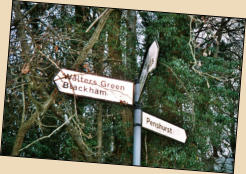
One of the difficulties in researching Blackham’s
story is that it is just a small part of Withyham
parish and most of the written evidence has to be
extracted from documents about that village. Many
a Blackham resident is listed as being ‘of
Withyham.’
Defining the border
And the problem is not made easier by the problem
of defining where the border of the two villages is.
We know the western border of Blackham - the
parish boundary with Hartfield. To the north it
nestles into Kent Water until that small river joins
the River Medway and starts to form the eastern
border.
But how far south does Blackham go before it
becomes Withyham village?
Some would say no further than Beech Green
House. But there is a case to claim that the village
extends as far as the river at Summeford Farm, for
surely it must include Blackham Court? Certainly
the maps of the Manor of Blackham in the
Buckhurst Terrier, a survey taken in 1597-1598,
suggest that was the boundary.
The other justification for such a claim comes
from the former Withyham vicar, the Rev Sutton’s
disparaging remarks that in Blackham ‘Sunday
was was entirely disregarded. Idlers were to be
seen about the lanes, passing the day playing pitch
and toss &c., whilst others were drinking and
fighting.’
Part of the reason for that disregard for the sabbath
might have been that with Blackham church not
built until 1902, villagers had to walk to Withyham
and as the Summerford name suggests, that might
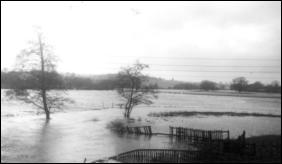
not have been easy in winter. It certainly wasn’t in
1951 as the picture left shows.
Sutton himself admits in his explanation of why
Lord Buckhurst moved to Knole between 1603-5
that ‘Some have thought that Queen Elizabeth
wished to have him within easier reach of her Court
and Councils, especially as the roads in the
neighbourhood of Buckhurst were at times
impassable.’
But wherever the border, Blackham is a village that
people who know it return to time and again. So if
you haven’t been, why not give it a try?
Remember, if you are coming from Tunbridge Wells
and you pass the Sussex Oak, you have gone too far.
Similarly, if you are coming from East Grinstead
and see the sign for Ashurst, you need to turn round.
If you are coming the back way from Edenbridge,
you are intrepid enough not to need any guidance!

Follow us on twitter @blackhamvillage
Join our Facebook Group
01274 584295
email: richard.coomber@virginmedia.com